World-Class High-Precision Glass Components Powering
Optical Communications in the AI Era
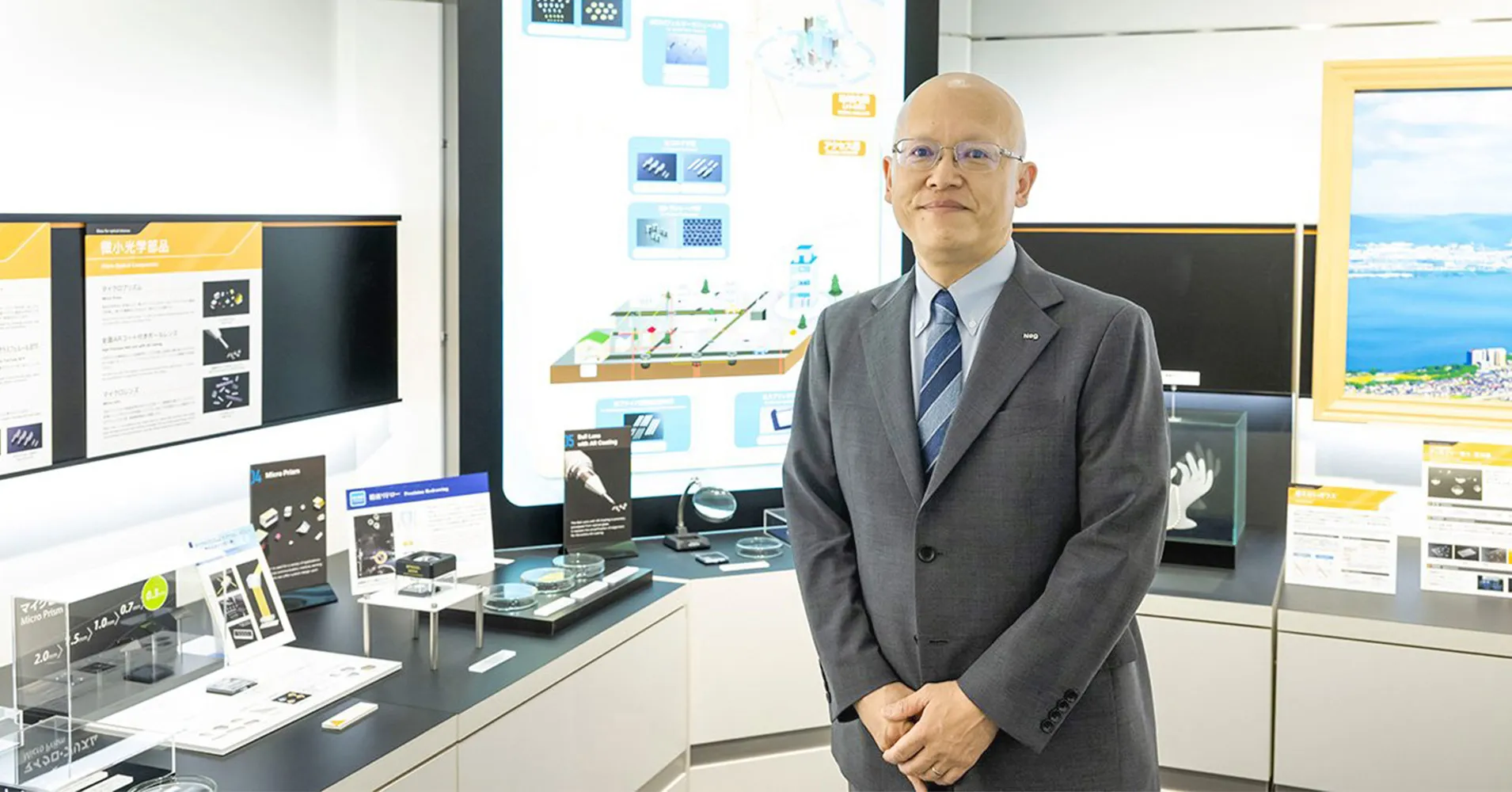


As AI adoption accelerates worldwide, data traffic both within and between data centers is growing dramatically, increasing the importance of optical communications. At the forefront of this trend is Nippon Electric Glass Co., Ltd. (NEG), which supplies precision glass components worldwide to support optical communications infrastructure. We take a closer look at the company's proprietary technologies and growth strategy.(Pictured above: Masahiro Kobayashi, Senior Vice President and Group General Manager, Electronic Products Group, Nippon Electric Glass Co., Ltd.)
【Article Published on Diamond Online】
The rapid adoption of AI is poised to transform global data communications infrastructure. In data centers, enormous GPU-equipped servers run around the clock, processing rapidly growing volumes of data. Demand for the optical communications components that carry this data is expanding at an unprecedented pace.
“Demand began rising sharply in the second half of the year before last. I've never seen demand grow this rapidly before,” says Masahiro Kobayashi, Senior Vice President and Group General Manager of the Electronic Products Group at NEG. Headquartered in Otsu, Shiga Prefecture, NEG has supplied specialty glass supporting technological advances since its founding in 1949, guided by the philosophy of making “glass that meets the demands of advancing civilization.” Its products have evolved from glass for radio vacuum tubes to cathode-ray tubes and flat-panel displays. Today, the company is focusing on precision glass components for optical communications as the latest expression of that philosophy.
Behind this shift is the rapid transition from conventional copper-based electrical connections to optical fiber communications. There are two main reasons. First, demand for higher-capacity, faster data transmission is growing. Compared with copper cables, optical fibers can carry far more data over longer distances at higher speeds. Second, power consumption is becoming a serious concern as AI data centers proliferate. Optical fiber communications consume far less power than copper-based transmission. This efficiency advantage is overturning the conventional assumption that optical connections are suitable for medium distances while copper is sufficient for short ones. Optical connections are now being adopted even for relatively short links between server racks.
Capillaries and Glass Polarizers
Unseen Glass Components Shape Optical Performance
Optical fibers form the backbone of optical communications networks. But optical devices that transmit, receive, and split light also contain tiny, highly precise glass components. Two such products in which NEG holds a significant share of the global market are high-precision capillaries and glass polarizers.
A typical optical fiber used for communications has an outer diameter of just 125 micrometers. A capillary is an extremely fine glass tube that holds an optical fiber securely and precisely in place inside an optical device (see the photographs and illustrations below).
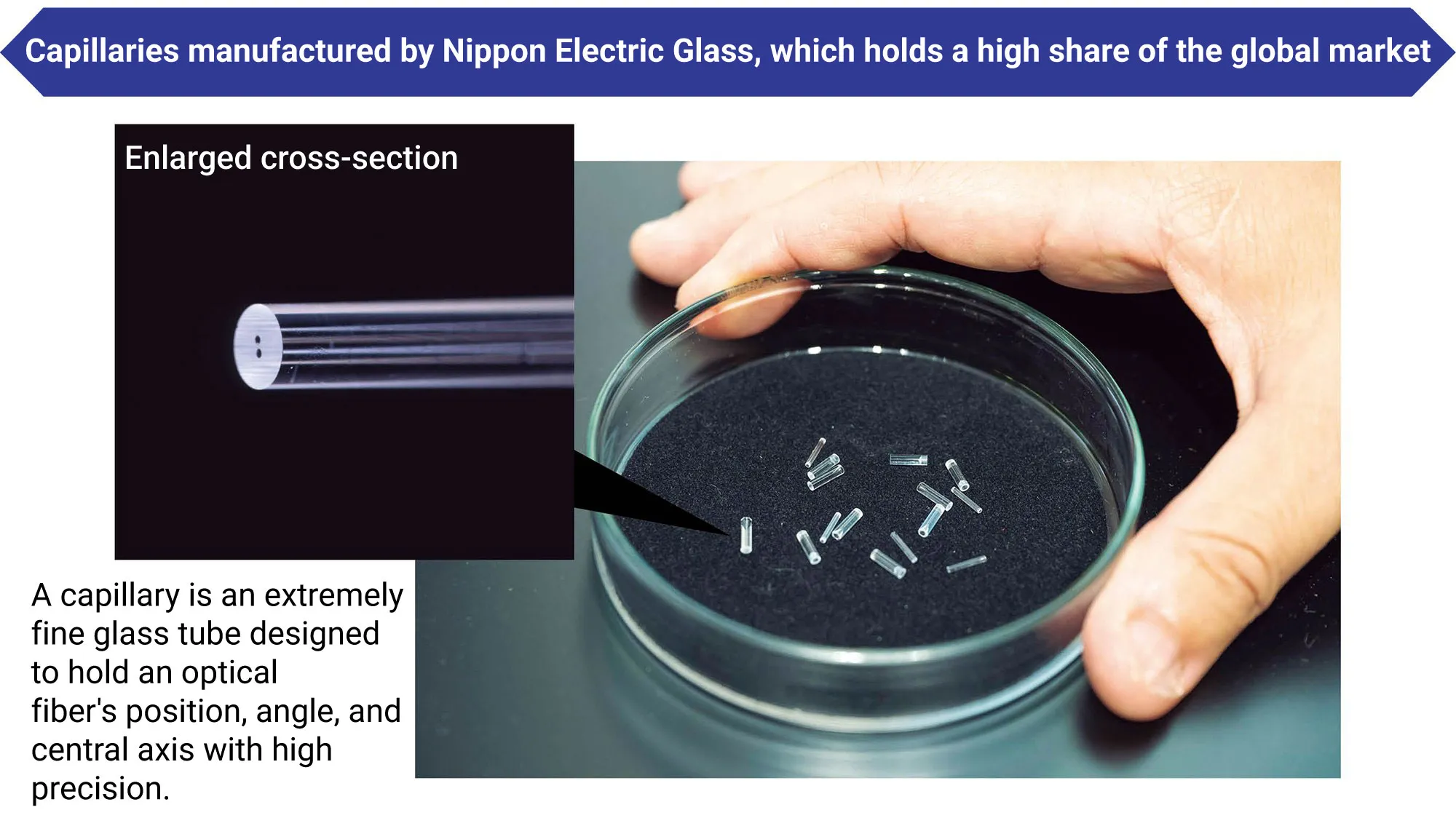
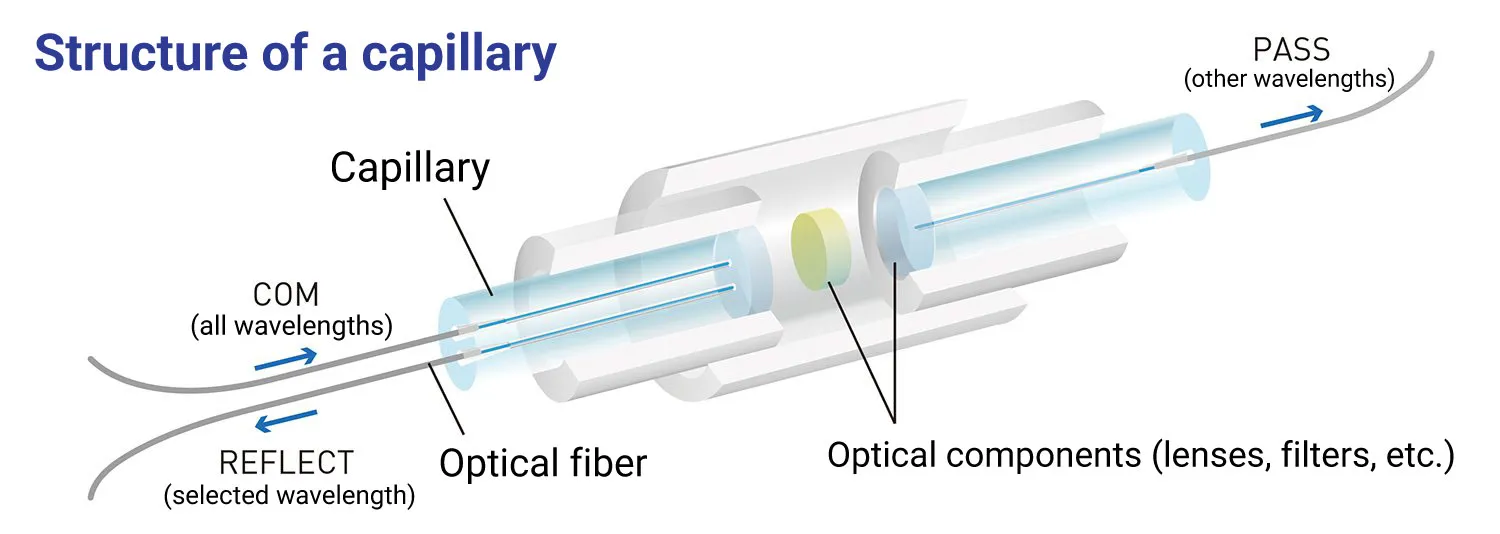
“Simply connecting optical fibers is not enough. Even a slight shift in their fixed position can cause light to leak, resulting in transmission loss. When that lost energy is dissipated as heat, electrical power is wasted as well. That is why we must control the position, angle, and central axis with a positioning accuracy of ±a fraction of a micrometer,” Kobayashi explains.
Glass polarizers, by contrast, look like small glass sheets, but contain elongated silver nanoparticles densely aligned within the glass.
“Light behaves like a wave and vibrates in different directions. A polarizer acts as a filter, allowing only light vibrating in a particular direction to pass through.”
This property is crucial in optical isolators, devices that help lasers operate reliably. When used in combination with other optical elements, a glass polarizer helps block reflected light from returning to the laser source, thereby protecting the laser.
These small, largely unseen glass components play an essential role in maintaining the quality of optical communications infrastructure in the AI era.
Individual Product Pages
Few Companies Worldwide Can Make These Components
Expertise Built Over More Than 40 Years
Why does NEG command a high share of the global market for capillaries and glass polarizers? Kobayashi's answer is straightforward: “Our strength lies in the technologies and experience we have accumulated to consistently achieve the exceptional precision these products require.” In fact, the barriers to entry are high, and only a small number of companies worldwide have the capabilities to manufacture these components.
Capillaries are manufactured through a process called redrawing. A glass-tube preform is heated until it softens, then drawn down to approximately one-hundredth of its original diameter while maintaining the shape and dimensional accuracy of its cross-section. Because surface tension tends to make heated glass round, precise temperature regulation and process control are essential.
In recent years, demand has grown for a wider variety of shapes, including designs with two or four holes and others with rectangular openings that accommodate several fibers side by side. These variations have made production even more challenging. NEG has manufactured capillaries since the 1980s, continually refining its proprietary furnaces and control systems. This accumulated expertise is a major strength.
Glass polarizers, meanwhile, are made by uniformly stretching silver-containing glass in one direction. In addition to careful glass-composition design, their production requires several processes to be performed to exacting standards, including precision polishing and thin-film coating to enable efficient light transmission. Although NEG began making glass polarizers only about a decade ago, their manufacture also draws on technologies honed over many years through the development of a diverse range of glass products.

“We meet demanding requirements by combining technologies we already possess, including the drawing techniques developed for capillaries, polishing techniques used for image-sensor cover glass, and coating techniques used for optical communications lenses.”
Until a few years ago, products for optical communications accounted for only around 1–2% of NEG's total sales. If the current pace of growth continues, Kobayashi believes that this share could exceed 10% within the next year or two.
Photonic-Electronic Integration: The Next Frontier
Glass Technology at the Heart of Next-Generation Optical Infrastructure
NEG is also preparing for developments further ahead. One emerging trend in optical communications is co-packaged optics (CPO), which integrates optical and semiconductor components within a single package as part of the shift toward photonic-electronic integration. Kobayashi expects that, as CPO becomes more widely adopted, glass components capable of guiding light precisely into, out of, and within devices will become even more important.
The company is already seeing an increase in inquiries about microlens arrays, in which multiple tiny lenses are arranged together, and prism lens arrays that redirect light.
“I expect the light-focusing performance of each lens, as well as the positional accuracy between lenses, to become increasingly important. We have already received requests for prototypes incorporating dozens of lenses, and evaluations are underway with a view to starting mass production around 2027 or 2028.”
Kobayashi adds: “Optical communications infrastructure will continue to evolve toward higher capacity, smaller form factors, and lower power consumption. We will continue developing the enabling technologies needed to respond promptly to our customers' advanced requirements as they arise.”
With end-to-end capabilities spanning materials development, melting, forming, processing, and analysis, NEG is helping support the optical communications infrastructure of the AI era. By combining its diverse technologies, the company will continue to create glass that meets the demands of advancing civilization.
Individual Product Pages