Presentation at the European Phase-Change and Ovonic Symposium (EPCOS 2025)—Glass thin film for Next-Generation Memories Contributing to an AI-Driven society
Nippon Electric Glass Co., Ltd. (Head Office: Otsu, Shiga, Japan; President: Akira Kishimoto; “NEG”) and Tohoku University Graduate School of Engineering are going to present the results of their joint research on glass thin films for next-generation memories at EPCOS 2025. EPCOS 2025 is an international conference on semiconductor materials held in France from September 23 (Tue) to September 26 (Fri), 2025.
For AI and data centers, next-generation memories with large capacities and high speeds are essential for processing ever-growing volumes of data. In addition, improving energy efficiency has become a critical challenge. Our results show great potential for solving these problems.
Background
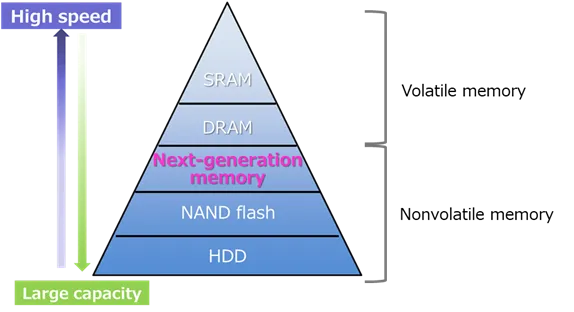
The rapid spread of AI and IoT generates enormous amounts of data every day, increasing the demand for higher processing performance in devices such as PCs and smartphones. Moreover, reducing the power consumption has become a pressing challenge for data centers. To address these issues, next-generation memories are attracting growing attention.
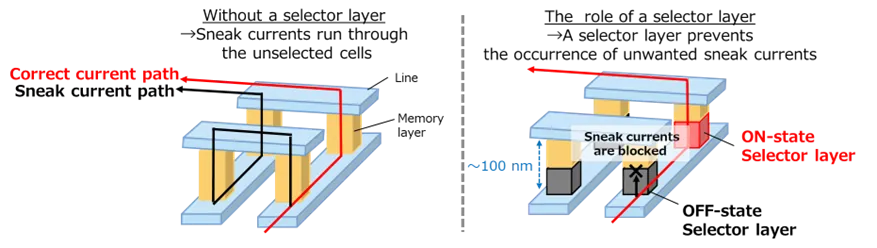
Next-generation memory typically employs a three-dimensional cross-point structure that is suitable for achieving a large capacity. Each memory cell consists of a memory layer and switch layer (selector), the thickness of them are nano-meter order. Without a proper selector, electrical currents through unintended paths, called sneak currents, can cause malfunction or performance degradation. A selector is an essential element that blocks sneak currents and enables stable operation.
Through collaboration with Tohoku University, we developed a proprietary glass material optimized for use in the selector layer. In this study, we report the outstanding characteristics of thin films made from this material when used as selector layer.
Key Features of the Developed Glass Thin Film
• Excellent selectivity: Exhibits a large ON/OFF current ratio, effectively blocking the leakage current and enabling stable operation of large-capacity memory.
• Low power consumption: Achieves threshold switching at low voltages, thereby improving the energy efficiency of memory devices.
• Safety and environmental friendliness: Unlike conventional materials, the new composition eliminates As, achieving a safer and more environmentally sustainable design.
Event Details
• Event Name: European Phase Change and Ovonic Symposium (EPCOS 2025)
• Dates: September 23 (Tue) to 26 (Fri), 2025 (local time, France)
• Venue: Aix-Marseille Université, France
• Presentation Date & Time: September 25 (Thu), 16:45–17:00 (local time)
• Presentation Title: High-Selectivity Ge-Te-Based Ovonic Threshold Switching Material for Selectors
• Official Website: https://epcos2025.fr/
International reputation
A paper summarizing these results, published on July 1, 2025 in Scientific Reports, an online journal from Nature Portfolio, has already recorded more than 1,000 views, reflecting strong global interest.
• Article Title: Arsenic-free Ge-Te-based ovonic threshold switching material with reduced leakage current
• URL: https://www.nature.com/articles/s41598-025-01323-5