Compliance
- Compliance System
- Whistleblowing System
- Ensuring Compliance
- Measures to Prevent Corruption
- Prohibition of Conflicts of Interest
- Efforts to Prevent Involvement with Antisocial Forces
- Prohibition of Money Laundering
- Measures to Maintain Fair Business Dealings
- Prohibition of Insider Trading
- Import and Export Control Initiatives
- Our Tax Accounting Policy
Compliance System
We established our Compliance Committee as a specialized body that ensures our Group members continue to comply with laws and regulations. The Committee also provides information on corporate ethics and is primarily focused on the items listed below.
Key Focus Areas of the Compliance Committee
-
Drafting revisions to the Group Code of Conduct and Principles of Activities
-
Collecting and analyzing information on compliance and providing compliance training
-
Operating the whistleblowing system (NEG Hotline)
Whistleblowing System
The Company and its subsidiaries in Japan and overseas maintain whistleblowing systems to help prevent legal violations, wrongdoing, and unethical acts within the Group, and to enable early detection and prompt resolution if such acts occur.
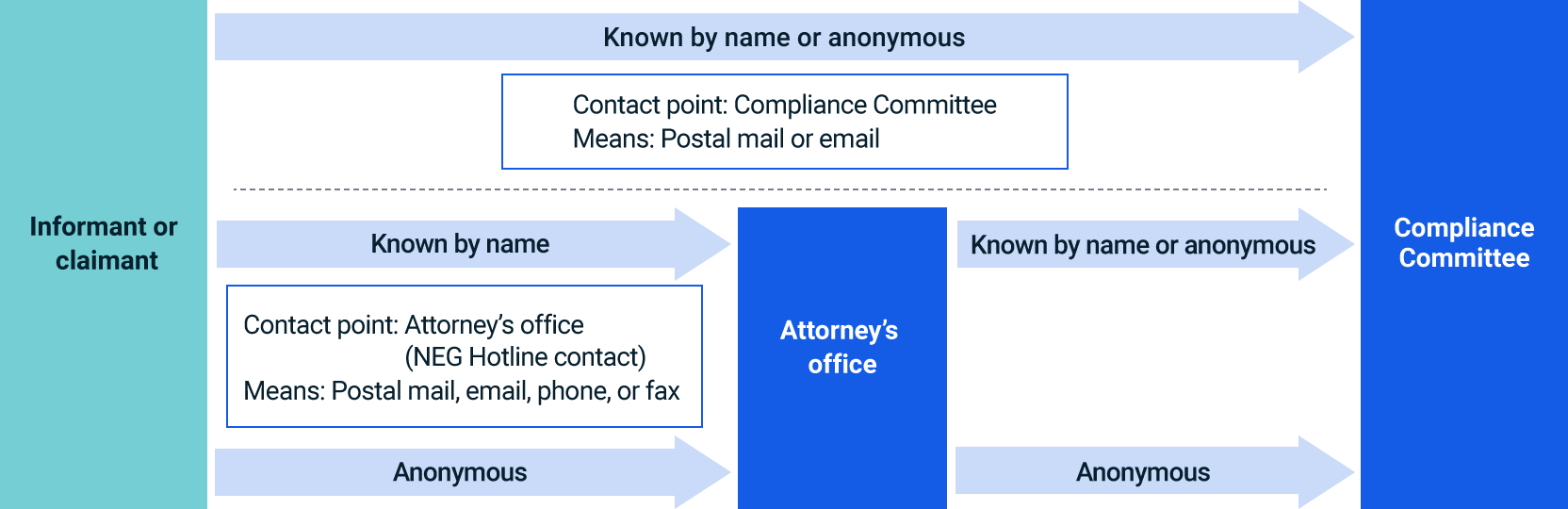
The NEG Hotline in Japan provides two channels for reporting and consultation: an internal line to the Compliance Committee and an external line to an attorney’s office. Hotlines overseas are also available for reporting and consultation through external attorney’s offices and consultation services.
The Company and its subsidiaries in Japan and overseas regularly promote awareness of the whistleblowing systems and operate them under strict safeguards to prevent any disadvantage to informants and to ensure the strict confidentiality of all reported information.
| Fiscal 2021 | Fiscal 2022 | Fiscal 2023 | Fiscal 2024 | Fiscal 2025 | ||||||||||||||||||||||
| 12 | 25 | 16 | 18 | 33 | ||||||||||||||||||||||
Ensuring Compliance
Training and Education
To raise compliance awareness of ethical standards, human rights, and other issues throughout our Group, each year we carry out compliance training as a part of an education program for newly hired employees and antitrust law seminars for employees engaged in sales activities. We also ensure awareness among management by holding workshops for directors and executive officers. At these sessions, participants take the opportunity to discuss themes such as governance and compliance.
In addition, we have designated October as Compliance Awareness Month, during which we conduct compliance-related lectures and workshops throughout our Group companies both in Japan and overseas, and also put up compliance awareness posters throughout our facilities. Moreover, we ask all executives and employees in Japan and overseas to provide the company with signed declarations each year promising that they will abide by the Principles of Activities. This gives them the opportunity to reflect on how they carry out their work in terms of compliance.
| Community Contribution | Name | Target | Times | Participants | Theme | |||||||||||||||||||||
| Companies in Japan | Education for new employees (new graduates) | All new employees (new graduates) | 3 | 58 |
|
|||||||||||||||||||||
| e-learning | Executives and employees at NEG and subsidiaries in Japan | – | 2,718 |
|
||||||||||||||||||||||
| Lectures | Executives and general managers at NEG, representatives of subsidiaries in Japan, area branch managers | 1 | 69 |
|
||||||||||||||||||||||
| Antitrust law seminar for sales departments | NEG sales representatives | 1 | 106 |
|
||||||||||||||||||||||
| Overseas companies | Workshops | Managers of subsidiaries in Europe, North America, and Malaysia | – | 147 |
|
|||||||||||||||||||||
As a result of these efforts, no cases occurred in fiscal 2025 of bribery, anticompetitive acts, or any other infraction requiring legal action. The result for the three years ended fiscal 2025 is as shown in the table below.
| Fiscal 2023 | Fiscal 2024 | Fiscal 2025 |
| 0 | 0 | 0 |
Group Code of Conduct and Principles of Activities
To ensure that all employees are informed on compliance matters, we have established the Group Code of Conduct and Principles of Activities. Wallet-sized cards printed with the Corporate Philosophy Structure, Code of Conduct, Principles of Activities, and an introduction to the NEG Hotline are distributed to employees of Group companies in Japan.
Measures to Prevent Corruption
With increasing globalization, the importance of preventing corrupt actions such as bribery in international transactions is being recognized worldwide.
Our Group Code of Conduct prohibits the bribery of public officials or others in positions of public service in Japan or any other country. The issue of preventing corruption is addressed in compliance training at our Group companies both in Japan and abroad, held during Compliance Awareness Month.
Prohibition of Conflicts of Interest
The executives and employees of our Group are prohibited from engaging in conflicts of interest that sacrifice the interests of the Company and result in personal gain for themselves or the provision of benefits to third parties such as relatives and friends.
Under this policy, the Company has established rules such as the approval request process and application forms and takes appropriate measures to prevent conflicts of interest using these internal control measures.
Efforts to Prevent Involvement with Antisocial Forces
As part of our commitment to maintaining the highest ethical standards, the Group Code of Conduct enforces a strict policy of “taking a firm stance against antisocial forces.” This principle is further detailed in the Group Principles of Activities, which provide clear guidelines on expected behavior. To ensure widespread understanding, these principles are distributed to all executives and employees as wallet-sized reference cards.
In line with this policy, our General Affairs Division leads efforts in gathering relevant information and, when necessary, coordinates with legal experts, law enforcement, and other organizations to handle such matters systematically.
Prohibition of Money Laundering
The Group prohibits its executives and employees from engaging in money laundering, which is the concealment or disguise of funds obtained through illegal activities.
Measures to Maintain Fair Business Dealings
We recognize the importance of adhering to antitrust laws in promoting fair international dealings.
Our Group Principles of Activities prohibits actions such as price-fixing or cartel agreements, and based on the internal rules at our Group companies inside and outside Japan, any contact with a director and an employee of a competitor must be requested ahead of time and reported on afterwards.
Antitrust law is addressed in compliance training conducted during Compliance Awareness Month at Group companies in Japan and overseas. We also conduct an antitrust law seminar for sales department personnel.
Prohibition of Insider Trading
The Group prohibits its executives and employees from engaging in insider trading, which involves the trading of securities based on undisclosed material information about the Group, or undisclosed material information about business partners or other parties obtained in the course of business or transactions.
Under this policy, the Company has established rules on insider trading, which are regularly reviewed to ensure they remain aligned with current conditions. Regular training is also provided to ensure appropriate preventive measures are in place.
Import and Export Control Initiatives
We have established a Trade Control Committee as part of efforts to ensure thorough implementation of export controls and compliance with various export-related legal requirements, such as the Foreign Exchange and Foreign Trade Act. The Trade Control Committee scrutinizes the implementation of export control procedures, facilitates Foreign Exchange and Foreign Trade Act-related training, and develops internal rules and regulations.
The Specified Export Declaration Office and a Special Import Declaration Office ensure compliance with import and export customs procedures and tax reporting, and support trade operations in accordance with the Customs Act and other tariff-related laws. Group-wide audits and employee training are conducted to ensure thorough compliance and strengthen awareness in our operations.
These and other initiatives have earned us certification as an Authorized Economic Operator (AEO) by Kobe Customs for both exports and imports. This is a status conferred on those economic operators that have well-developed cargo security controls and legal compliance structures in place. Thanks to this, not only the Company but also its overseas subsidiaries are conferred AEO mutual recognition, thereby expediting smoother import and export customs procedures. We are the only Japanese glass manufacturer to be certified as an AEO for both imports and exports (As of April 10, 2026).
Our Tax Accounting Policy
The Group complies with the tax-related laws and regulations of each country and region to ensure appropriate payment of taxes. We recognize this as a means of contributing to the socio-economic stability and development of these countries and regions, as well as of contributing to the stability of our Group business. The Group does not make use of any tax havens for the purpose of tax avoidance.
Tax Accounting Governance
Responsibility for Group tax accounting governance is assumed on an item-by-item basis by executive officers of the departments responsible for each tax item. In addition, each department is in charge of supervising the appropriateness of tax accounting.
Transfer Pricing Tax System
The Group utilizes a transfer pricing calculation method based on the OECD Transfer Pricing Guidelines, as well as the transfer pricing taxation systems of each country, to determine transaction prices between Group companies according to an analysis of respective Group company functions, assets, and risks. Also, in order to maintain the predictability of transfer pricing taxation, we utilize advance pricing agreements (APA) when called for to ensure appropriate payment of taxes.