Corporate Governance
- Our Corporate Governance Policy
- Overview of the Corporate Governance Structure
- Corporate Governance Structure
- Analysis and Evaluation of the Effectiveness of the Board of Directors
- Outside Directors and Outside Corporate Auditors
- Skills Matrix of Director and Corporate Auditor
- Director and Corporate Auditor Remuneration Policy
- Cross-shareholdings Policy
Our Corporate Governance Policy
We believe that to increase corporate value and achieve sustained growth, it is essential to continue to ensure managerial transparency and strengthen supervisory functions regarding the execution of business. This is our basic policy on corporate governance, and we will strive to improve our organization and business systems in accordance with this policy.
Overview of the Corporate Governance Structure
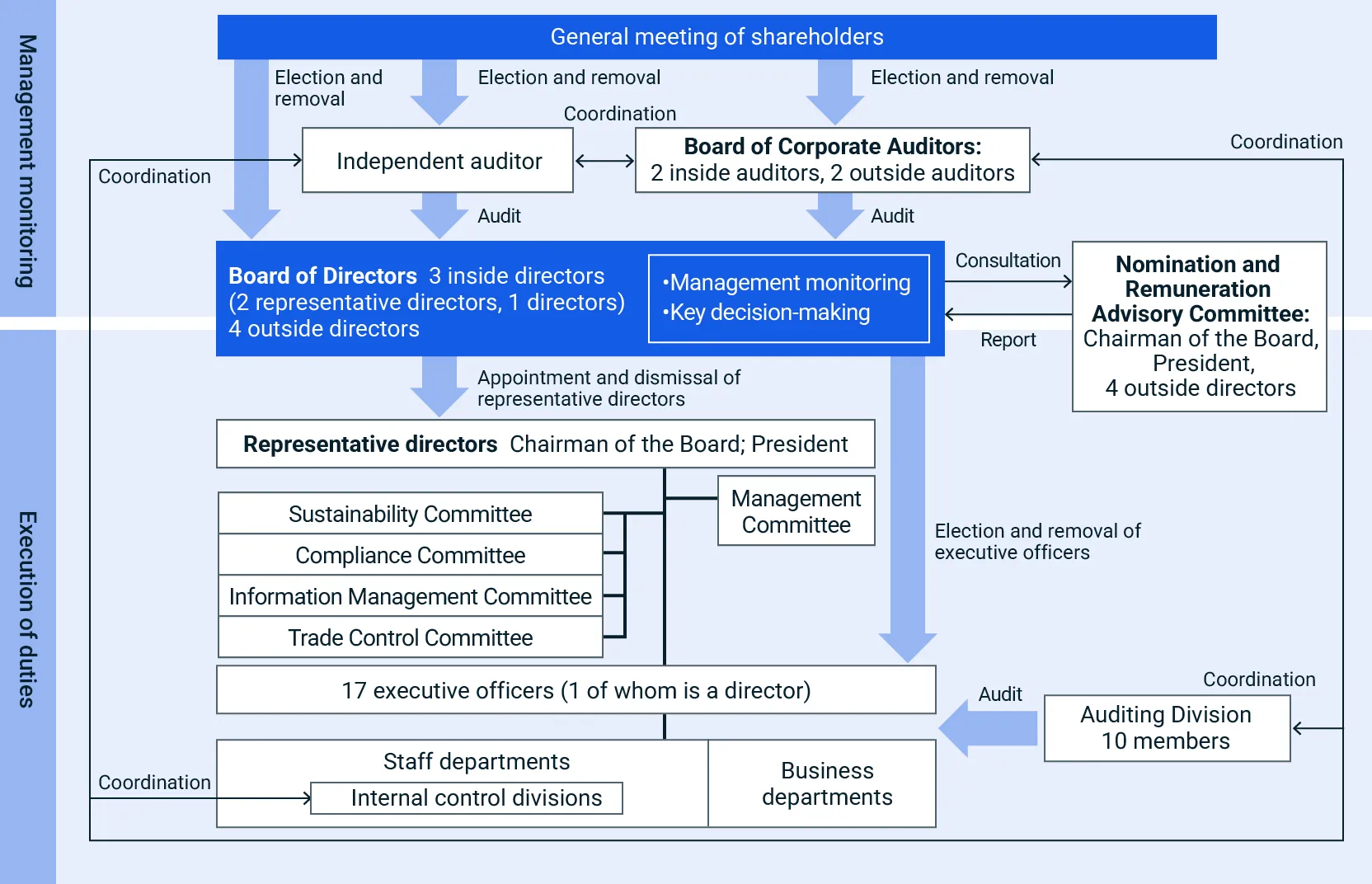
The Company employs a corporate structure with a Board of Corporate Auditors. The Board of Directors, which includes outside directors, carries out decision-making regarding the execution of duties and supervision of the execution of duties by directors and others. The supervision of the directors is carried out independently of the Board of Directors and the executive structure by the Board of Corporate Auditors, which includes outside corporate auditors. This system is intended to ensure the transparency and fairness of the Board of Directors.
Also, a Nomination and Remuneration Advisory Committee, which exists as a voluntary committee, has been established as an advisory body to the Board of Directors. The committee deliberates on the appropriateness of matters related to the appointment and dismissal of representative directors, remuneration policies and systems for directors, and the amount of remuneration determined for directors. It then reports its conclusions to the Board of Directors.
In addition, the Sustainability Committee, the Compliance Committee, the Information Management Committee, and the Trade Control Committee facilitate organization-wide initiatives to strengthen corporate governance.
| 2000s | 2010s | 2020s | ||||||||||||||||||||||||
|---|---|---|---|---|---|---|---|---|---|---|---|---|---|---|---|---|---|---|---|---|---|---|---|---|---|---|
| Settlement and shares | 2006 Takeover defense measures introduced |
2012 Takeover defense measures abolished |
||||||||||||||||||||||||
| Business execution Supervision system |
2001 Executive officer system introduced Start of reduction in the number of directors |
2015 First independent outside director appointed |
2020 Nomination and Remuneration Advisory Committee established |
|||||||||||||||||||||||
| 2003 Term of office for directors shortened to one year First independent outside corporate auditor appointed |
2016 Independent outside directors increased to two Start of evaluation of Board of Directors effectiveness |
2023 Non-Japanese executive officer appointed Corporate advisor system abolished |
||||||||||||||||||||||||
| 2019 Independent outside directors increased to three (outside directors now comprise one-third) System for granting restricted shares introduced First female outside director appointed |
2025 Independent outside directors made a majority of the Board of Directors |
|||||||||||||||||||||||||
| Internal control and risk management | 2000 Principles of Activities established |
2015 Corporate Philosophy Structure established Business continuity plan formulated |
2023 CSR Committee established |
|||||||||||||||||||||||
| 2003 Auditing Division established |
2019 Whistleblowing system introduced for all Group companies |
2026 |
||||||||||||||||||||||||
| 2006 NEG Hotline whistleblowing system introduced Compliance Committee established |
||||||||||||||||||||||||||


| Position | Name | Board of Directors | Board of Corporate Auditors | |||||||||||||||||||||||
|---|---|---|---|---|---|---|---|---|---|---|---|---|---|---|---|---|---|---|---|---|---|---|---|---|---|---|
| Representative directors | Motoharu Matsumoto | 18/18 meetings (100%) | – | |||||||||||||||||||||||
| Akira Kishimoto | 18/18 meetings (100%) | – | ||||||||||||||||||||||||
| Director | Mamoru Morii | 18/18 meetings (100%) | – | |||||||||||||||||||||||
| Outside directors | Reiko Urade | 18/18 meetings (100%) | – | |||||||||||||||||||||||
| Hiroyuki Ito | 18/18 meetings (100%) | – | ||||||||||||||||||||||||
| Yoshio Ito | 18/18 meetings (100%) | – | ||||||||||||||||||||||||
| Nahomi Aoto | 18/18 meetings (100%) | – | ||||||||||||||||||||||||
| Full-time corporate auditors | Yoshihisa Hayashi | 18/18 meetings (100%) | 13/13 meetings (100%) | |||||||||||||||||||||||
| Toshiharu Narita | 14/14 meetings (100%) (since being appointed in March 2025) | 10/10 meetings (100%) (since being appointed in March 2025) | ||||||||||||||||||||||||
| Outside corporate auditors | Yukihiro Yagura | 18/18 meetings (100%) | 13/13 meetings (100%) | |||||||||||||||||||||||
| Hiroji Indoh | 17/18 meetings (94%) | 13/13 meetings (100%) | ||||||||||||||||||||||||
Corporate Governance Structure
Board of Directors
The Board of Directors makes decisions on important management affairs of the Group and supervises the execution of business affairs. As of March 27, 2026, the Board of Directors consists of seven members (including two representative directors, one inside director, and four outside directors). The Board of Directors is presided over by the Chair of the Board. To achieve clarity of management responsibility and develop a flexible management system capable of responding to changes in the business environment, the term of directors is set at one year. Regular Board of Directors meetings are held monthly, and extraordinary Board of Directors meetings are held when necessary.
In addition, at the annual budget meeting, the Board of Directors monitors management by hearing explanations directly from the respective executive officers about the business outcomes of the current fiscal year and the budget of the next fiscal year.
The reasons for appointing each director are included in the Notice of the 107th Ordinary General Meeting of Shareholders (held on March 27, 2026) and can be found on our website.
Board of Corporate Auditors
We employ a corporate auditor system. As of March 27, 2026, the Board of Corporate Auditors consists of four corporate auditors, two of whom are outside corporate auditors. Corporate auditors conduct audits of the directors’ execution of their duties through assessing business affairs and corporate assets and setting important audit issues according to auditing policies, plans, and assignment of duties established by the Board of Corporate Auditors. They also participate in Board of Directors meetings. Meetings of the Board of Corporate Auditors are held monthly, in principle, and corporate auditors share information and exchange opinions at these meetings.
Corporate auditors endeavor to improve the effectiveness of their audits by deepening their understanding about the Company’s business operations. For this purpose, the corporate auditors take various measures, such as attending the annual budget meeting and periodically questioning directors and executive officers about their duties and handling of business affairs.
Nomination and Remuneration Advisory Committee
As part of our efforts to strengthen our corporate governance, the Company established the Nomination and Remuneration Advisory Committee to ensure transparency and objectivity in the appointment and dismissal of representative directors and in the process of determining director remuneration. The Committee deliberates on the appropriateness of matters related to the appointment and dismissal of representative directors, remuneration policies and systems for directors, and the amount of remuneration determined for directors. It then reports its conclusions to the Board of Directors.
The committee met four meetings in fiscal 2025. Evaluation and allocation of the monthly remuneration (fixed) and bonus for each director (excluding outside directors) does not need to be reported to the Board of Directors, and decisions of the Committee are deemed to have the approval of the Board of Directors.
As of March 27, 2026, the Committee comprises two representative directors and four outside directors. Its membership is shown below.
| Chair | Yoshio Ito (outside director) | |||||||||||||||||||||||||
| Members | Motoharu Matsumoto (chair of the Board) | |||||||||||||||||||||||||
| Akira Kishimoto (president) | ||||||||||||||||||||||||||
| Reiko Urade (outside director) | ||||||||||||||||||||||||||
| Nahomi Aoto (outside director) | ||||||||||||||||||||||||||
| Katsura Nakano (outside director) | ||||||||||||||||||||||||||
Management Committee
The Management Committee deliberates on the Company’s important managerial affairs and draws up detailed action plans regarding the decisions made at the Board of Directors meetings. Management Committee meetings are held twice a month and when deemed necessary.
As of March 27, 2026, the Management Committee comprises three inside directors (two of whom are representative directors), one executive vice president, and eight senior vice presidents.
Executive Officers
We adopt an executive officer system to promote faster decision making, ensure managerial transparency, and enhance the execution of business affairs. As of March 27, 2026, in addition to the president, there are 17 executive officers (one of whom is a director, one of whom is French). Each executive officer serves for a term of one year.
Analysis and Evaluation of the Effectiveness of the Board of Directors
All directors and corporate auditors participate in an annual questionnaire concerning the effectiveness of the Board of Directors. The questionnaire focuses on (1) the Board of Directors in general, (2) the running of Board of Directors meetings, and (3) outside directors.
Fiscal 2024 Questionnaire Questions, Opinions, and Action Taken
-
(1) To the question “What is your opinion on the composition of the Board of Directors with respect to the medium- to long-term outlook for management policies and issues, and to the strengthening of supervisory functions?”, responses appreciated that the majority of the Board is outside directors but also said a system is needed to support adequate discussion of key issues. In fiscal 2025, the Board of Directors introduced time for executive officers to report on the areas they oversee and are responsible for.
-
(2) On the topic of “company efforts to provide outside directors with opportunities to visit plants in Japan and overseas and exchange opinions with local executives,” a comment expressed the hope that outside directors would be given more opportunities to visit plants and engage in discussions with management so they can better understand conditions on the ground. In fiscal 2025, outside directors met with the Board of Directors at the Shiga-Takatsuki Plant and had opportunities to tour the plant and speak with senior employees.
Fiscal 2025 Questionnaire Opinions
The composition of the Board of Directors was viewed as well balanced between inside and outside directors, and there was also an opinion that the ratio of female directors should be increased to 30% or more over the medium to long term.
Another opinion noted that the number and volume of agenda items vary from month to month, and that sufficient time should be allocated to discuss the Company’s policies and key issues.
Based on the results of the questionnaire, we have determined that the Board of Directors is viable and that its effective functioning has been ensured. We will continue our efforts to enhance discussions at Board of Directors meetings by using the questionnaire results as a basis for making improvements and evaluating its effectiveness.
Outside Directors and Outside Corporate Auditors
As of March 27, 2026, there are four outside directors and two outside corporate auditors within the Company. Outside directors make up a majority of the Board of Directors, which includes two female outside directors. To strengthen the oversight capabilities of the Board of Directors and other corporate administrative bodies and ensure access to informed and objective advice, the Company appoints outside directors with diverse expertise. These include a corporate management expert with many years of firsthand knowledge and experience in the world of corporate management; an economist with extensive experience in environmental policy, applied microeconomics, and human resource development, as well as specialized knowledge in industrial organization; a science expert who is specialized and highly experienced in the field of agricultural sciences; and a technical expert with extensive experience and expertise in technology development and a proven track record in the technology development department of a global company and involvement in human resource development.
Outside corporate auditors consist of one certified public accountant and tax accountant and one attorney at law, who are both independent from the Company and are highly knowledgeable and experienced in their respective fields. They proactively perform their auditing duties and reinforce supervisory functions.
We base our determination of the independence of outside directors on the criteria established by the Tokyo Stock Exchange as well as on our own “Independence Standards for Outside Directors and Outside Corporate Auditors” described below.
No personal, capital, or business relationship, nor any other interest to which any of the above-mentioned criteria apply, exists between the outside directors and the Company, and in light of the fact that they fulfill all of the requisite criteria, we have registered all our outside officers as independent directors and auditors with the Tokyo Stock Exchange.
Skills Matrix of Director and Corporate Auditor
Director and Corporate Auditor Expertise and Backgrounds
For the Company to respond flexibly to changing climate and business conditions, and to improve corporate value over the medium and long term, we consider it necessary for directors and corporate auditors to have specialized expertise as well as broad experience and diverse perspectives.
| Name | Position in the company | Outside independent | Gender | Nomination and Remuneration Advisory Committee (◎ indicates chairperson) |
Major knowledge, experience, and capabilities | ||||||||||||||||||||||||
|---|---|---|---|---|---|---|---|---|---|---|---|---|---|---|---|---|---|---|---|---|---|---|---|---|---|---|---|---|---|
| Corporate management and business strategy | Finance and accounting | Legal and compliance | R&D, manufacturing process development, and quality | Sales and marketing | Global | Sustainability | |||||||||||||||||||||||
| Motoharu Matsumoto | Chairman of the Board (representative director) |
Male | ● | ● | ● | ● | ● | ● | ● | ||||||||||||||||||||
| Akira Kishimoto | President (representative director) |
Male | ● | ● | ● | ● | ● | ● | ● | ||||||||||||||||||||
| Mamoru Morii | Director | Male | ● | ● | ● | ● | ● | ● | |||||||||||||||||||||
| Reiko Urade | Director | ● | Female | ● | ● | ● | |||||||||||||||||||||||
| Yoshio Ito | Director | ● | Male | ◎ | ● | ● | ● | ● | |||||||||||||||||||||
| Nahomi Aoto | Director | ● | Female | ● | ● | ● | |||||||||||||||||||||||
| Katsura Nakano | Director | ● | Male | ● | ● | ● | ● | ||||||||||||||||||||||
| Yoshihisa Hayashi | Full-time corporate auditor | Male | ● | ● | |||||||||||||||||||||||||
| Toshiharu Narita | Full-time corporate auditor | Male | ● | ● | ● | ||||||||||||||||||||||||
| Hiroji Indoh | Corporate auditor | ● | Male | ● | |||||||||||||||||||||||||
| Yuichiro Katsura | Corporate auditor | ● | Male | ● | |||||||||||||||||||||||||
-
Note: The above table does not reflect all areas of expertise held by each director and corporate auditor.
| Skills | Reasons for selecting the skills |
|---|---|
| Corporate management and business strategy | Knowledge, experience, and capability in corporate management and business strategy are needed to determine management plans and strategic policies, including portfolio management, in order to achieve sustainable growth and increase corporate value. |
| Finance and accounting | Knowledge, experience, and capability in finance and accounting are needed to formulate and execute financial strategies to increase corporate value. These skills are needed not only for accurate financial reporting but also to ensure efficient business operations and use of capital. |
| Legal and compliance | Knowledge, experience, and capability related to legal affairs and compliance are required to ensure proper governance in business activities, compliance practices, and improve the effectiveness of management supervision at the Board of Directors. |
| R&D, manufacturing process development, and quality | Knowledge, experience, and capability in R&D, process development, and quality are needed to promote the integrated development of materials, processes, and products, accelerate product development and commercialization, strengthen existing businesses, and expand strategic businesses. |
| Sales and marketing | Knowledge, experience, and capability in sales and marketing are needed to fulfill our values and customer-first approach and to respond quickly to needs and seeds for strengthening existing businesses and developing strategic businesses. |
| Global | A deep understanding of and respect for local cultures and diversity are needed to accelerate the overseas business development in order to fulfill the medium-term management plan and realize our vision to be a world-leading specialty glass manufacturer. |
| Sustainability | Knowledge, experience, and capability in sustainability management are needed to meet growing expectations for companies to address climate change, human capital, human rights, and other key issues for sustainable growth, as well as to ensure full information disclosure and leverage business activities to address social challenges. |
Training for Directors and Corporate Auditors
During Compliance Awareness Month, held every October, we invite outside instructors to deliver lectures on compliance to our inside directors, full-time corporate auditors, and other executives. We also hold director training seminars every year, which provide our directors with a deeper understanding of current business conditions, including those surrounding corporate governance. Our corporate auditors participate in seminars and information exchanges with outside organizations, through which they deepen their auditing-related expertise.
For our outside directors and outside corporate auditors, prior to assuming office, we provide them with explanations about our current corporate situation and systems. After they have assumed office, we provide them with opportunities to conduct interviews with directors and executive officers.
Director and Corporate Auditor Remuneration Policy
Our executive compensation for directors (excluding outside directors) comprises a monthly retainer, performance-linked bonuses, and grants of restricted shares. For outside directors and corporate auditors, remuneration is limited to a monthly retainer. The total monthly remuneration and bonuses for directors are within the scope determined by the General Meeting of Shareholders, and the total amount of the bonus payment is determined at the General Meeting of Shareholders after deliberation by the Nomination and Remuneration Advisory Committee subject to the approval of the Board of Directors. The amounts of the monthly retainer and bonus for each individual director are commensurate with those of other companies and are aligned with our business performance (in the case of inside directors only), the economic environment, and objective market research data on remuneration provided by outside specialized agencies. Bonuses are determined using consolidated operating income as an indicator and in consideration of economic conditions, business conditions, status of executed measures, and individual evaluations.
Monthly remuneration and bonus content are deliberated on and decided by the Nomination and Remuneration Advisory Committee. Unless Committee members are equally divided in opinion, the Committee’s decisions are deemed as adopted by the Board of Directors.
After Nomination and Remuneration Advisory Committee consideration, taking into account individual duties, responsibilities, and share price, the Board of Directors grants restricted shares within the scope of the total amount determined by the General Meeting of Shareholders.The ratio of the monthly retainer, which is a fixed amount of remuneration, to the bonus and grants of restricted shares, which are variable amounts of remuneration, is generally 6:4 (fixed: variable) on a periodic payment basis.
Remuneration for corporate auditors is determined after consultation with the auditors within the scope of the total amount determined by the General Meeting of Shareholders after reference to what is offered by other companies as determined by surveys conducted by external specialized agencies.
| Category | Total amount of remuneration (million yen) |
Total amount for each type of remuneration (million yen) | Number of eligible officers | |||||||||||||||||||||||
|---|---|---|---|---|---|---|---|---|---|---|---|---|---|---|---|---|---|---|---|---|---|---|---|---|---|---|
| Fixed remuneration | Performance-linked remuneration | Non-monetary remuneration | ||||||||||||||||||||||||
| Directors (Number of outside directors) | 303 (39) |
209 (39) |
63 (–) |
29 (–) |
9 (4) |
|||||||||||||||||||||
| Corporate auditors (Number of outside corporate auditors) | 55 (14) |
55 (14) |
– (–) |
– (–) |
5 (2) |
|||||||||||||||||||||
| Total (Number of outside directors and corporate auditors) |
358 (54) |
265 (54) |
63 (–) |
29 (–) |
14 (6) |
|||||||||||||||||||||
Cross-shareholdings Policy
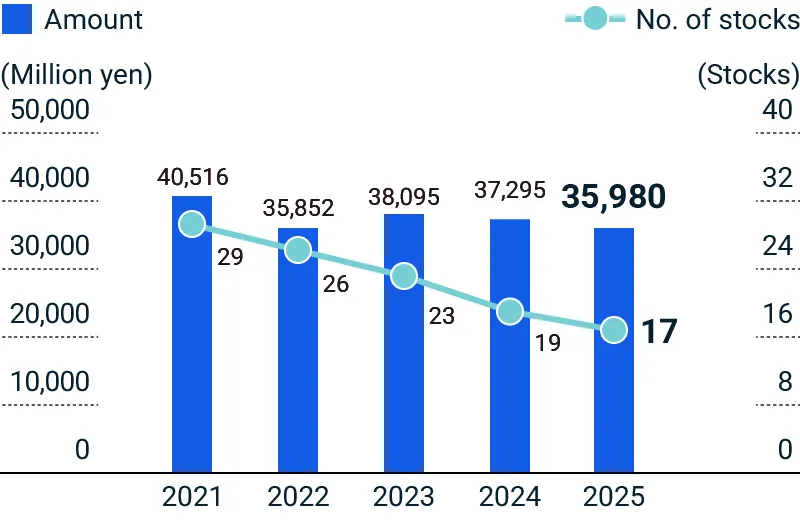
The Company does not hold cross-shareholdings except in cases where it recognizes the rationale for cross-shareholdings, such as business alliances and maintaining/enhancing business partnerships.
In addition, the Company considers changes in the business environment and verifies the appropriateness of holdings from a quantitative perspective based on capital costs and a qualitative perspective based on management strategy and other considerations.
The Company exercises voting rights relating to cross-shareholdings after comprehensively considering issues including whether or not a proposal effectively complies with the company’s shareholding policy and whether or not it would be expected to increase the corporate value of the issuing company.